NOTE: This is a compilation of narrative from a handful of members of the Alaska Karst Unified Exploration Project, aka AKUEP, from the inaugural project in 2024. Dive Alaska does not conduct these projects; however, employees and members of Dive Alaska make up some of the founding members, and Dive Alaska donates equipment and resources to the non-profit, citizen science, cave exploration project. Enjoy.
 “We Are All Mad Here”
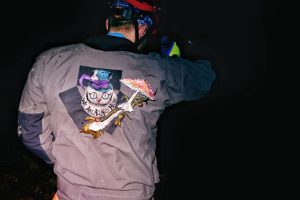
I stitched that phrase onto the back of my drysuit before setting off for AKUEP, complete with a Cheshire Cat grinning crazily from behind toadstool. For those that don’t know, that’s the Alaska Karst Unified Exploration Project.
And for those who don’t know what a Chesire Cat is… I’ll wait while you go watch Alice in Wonderland.
AKUEP (or POWIDUCK, or AKEB, or the other names it went by during planning) ran in July 2024. I sit writing this the day after the Philadelphia Eagles dismantled the Kansas City Chiefs in Superbowl LIX. That’s February 9th, 2025, for normal people who doesn’t know that date offhand.
I told myself I would, at a minimum, leave voice memos during the project, and write a narrative based off those. But voice memos don’t work if you don’t like the sound of your own voice. And trying to sum up something that significant feels like you need to give it the time and attention deserving of an endeavor that involved so much buy-in, time, sacrifice, and teamwork from so many people.
So, I delayed putting a narrative together, pushed off sorting through notes, and even neglected the whole thing entirely at times. Not because I didn’t care; quite the opposite. I cared too much. Everything about the project feels like a Thing Worth Saying, but there’s also the feeling that those Things Worth Saying should be said well. And I don’t know if I can say it well.
Some of that is a lie that gets repeated out of anxiety, some of it is making the task into something that it isn’t, and maybe, just a little bit, there’s some validity to that feeling. Especially when you’re trying to describe something that took almost seven years to pull together, and changed the direction of your life.
Kinda like falling down a rabbit hole, to steal a metaphor from Lewis Carrol.
Thankfully, between the notes, accounts, surveys, and interviews we did during the project, there is more than enough to compile a narrative, without relying on memory, and hopefully before AKUEP 2025.
Away we go.
 “We Are All Mad Here“
Meet the Team
This is a compiled narrative, based off the notes of the three cave divers involved in the project. It is limited in scope and scale, as these things usually are, because there isn’t much space to give all the characters in this story the biography and credit they deserve. If you would like to know more about any individual, most of us can be found through a minor Google search, and you can read more on their respective websites, social media, publications, etc.
Nor is there enough space to tell the whole story here. All the small interactions would encompass a long-form novel; the words of encouragement or jest, misplaced feet on muddy paths, core-shot ropes, interpersonal dynamics, ebbs and flows of mood and vision, etc. It’d take… I don’t know… almost seven years to write.
To put it simply: if AKUEP took seven years to pull together, to do it justice in retelling would take an equal amount of time.
Given that we are about seven months from when we wrapped the project, this is my attempt to help compile something before we do it all over again, and thankfully, I had a lot of help.
But first, let’s meet our cast…
Ron Fancher: Diving Operations, Narrative Compiler, Immensely Grateful for Eyesight, Brother of Alex
Hannah Keith: President of Glacier Grotto, Paraglider, Caving Logistics, Generally Great Hang
Alex Fancher: Diver, President of Diving Morale, Wilderness Standard-of-Living Raiser, Brother of Ron
Ian Clarke: Treasurer of Glacier Grotto, President of Caving Morale, Wilderness Automotive Mechanic
Orie Braun: Dive Safety Officer, Regional Director for the IUCRR (Florida/Alaska), Optimist
Kieran Grey: Caver, Photographer, Driver, Wildcard
Shelby Beck: Host, Boat Captain, Voice of Reason, Exceedingly Patient
Josh Andrews: Host, Rural High Pressure Gas Liaison, Boat Captain, Reason Why Shelby is So Patient
 Part 1: Getting There, While the Getting’s Good
Ron:
Three of our team members, myself, Alex Fancher, and Orie Braun, met in Anchorage on July 11th, and rounded up the last bits of equipment for the project, before departing the next day. Two of the members, Hannah Keith and Ian Clarke, were already on Prince of Wales, participating in POWI-DRY. Close to a thousand pounds of gear was waiting at the cargo terminal in Ketchikan, and we had a tight window to meet the next day. The Milk Run (a series of short, commuter flights from Anchorage to Ketchikan) was getting us into Ketchikan with a borderline-razor margin to collect a truck, pick up cargo, and get on the ferry to Hollis.
To give us a buffer, we enlisted team member Kieran Grey, who arrived in Ketchikan mere hours before us, to pick up Ian’s truck on the mainland, and start loading equipment. The only catch? None of us had ever met Kieran prior to this. That’s quite a bit of responsibility to put on someone you know, let alone someone you’ve only spoken on the phone with (“Hey, I have a favor to ask… Mind picking up a pickup truck, about a thousand pounds of specialty equipment, and three people from the airport? Oh, and if you don’t, it could tank the project. Alright, see you on the 12th! We hope!”).
Sometimes it pays to trust a stranger (especially when it’s your only option), and Kieran was already hauling Pelican cases in to the bed of Ian’s Dodge Dakota when we touched down in Ketchikan.
One of the most impressive achievements of the whole trip was managing to get four humans and all that gear into a two-door truck that’s cramped when it’s empty.
Orie:
I made it to Anchorage, from Florida, after a number of significant delays, and had a much-shortened window of time to gather the last minute items needed for the expedition. Boots, wet pants and jacket with gloves. Me and Alex gathered all this, while Ron continued prepping, and the day of departure came with some stress, but no incident.
After we made it through the Milk Run (for those not “in the know”, it’s a series of short flights on a commercial airlines to coastal towns throughout SE Alaska), we touched down in Ketchikan and took the ferry to the mainland.
The day called for rapid, but efficient, action, and we had to catch the first ferry (the Ketchikan airport is on an island, while Ketchikan itself is on the mainland) with enough of a buffer to make the serious, second ferry that would get us to Prince of Wals. This was also the last chance for affordable groceries. With all of this swirling around us, we gathered all of our essentials just in time for the ferry departure, and prayed we hadn’t forgotten anything.
The second ferry was roughly 3 hours and was a beautiful way to take in all the scenery while traveling. Similar to a cruise ship experience, but without the hassle.
Alex:
It was Sunday. We woke up at 5:00 AM. Ron, Orie, Kieran, and myself were sleeping in Josh and Shelby’s basement. Josh made breakfast and coffee, while we waited for one of our team members (not naming names), who has a sleep schedule of a teenager, get himself put together.
The whole day was dedicated to gear prep, and had been planned that way from the start. We used all of it.
Orie:
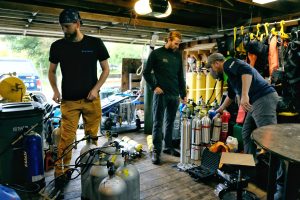
We had two different locations to set up and configure gear. One location at Josh and Shelby’s garage and, the other was Josh’s dad’s massive three-bay wood-shop. Of course, some of the dive gear did get a little wood dust on it, but that adds to the flavor of exploration diving. I spent most of my time organizing and sizing some of the gear I would be using.
Ron:
Today was the last day I had the illusion of control over this endeavor, and I was committed to using every second of it. I threw myself at gear preparation like a lunatic, and my acknowledgement of that here is probably the closest my teammates are ever getting to an “apology” for that first day.
There should have been an insurmountable amount of work to do, and it was only with a handful of very clever, albeit questionable, logistics tricks I’ve picked up, and an immense amount of help from Josh and Shelby, that everything went as smoothly as it did. Filling tanks, rigging cylinders, analyzing gas, configuring camera equipment, checking exploration reels and survey notebooks, charging power banks, and on and on and on. We woke up early, and went to bed exceedingly late.
But, when I closed my eyes on the floor of the laundry room in Josh’s house, I knew we were as prepared as we could be. Now, there was nothing to do but sleep.
Orie:
That evening we had a great invitation to go to Josh’s parents’ house for dinner. There we had egg rolls and stir-fry. His brother and wife were in town visiting from Italy. We talked about all the good things in the world and they continued to ask questions about what we were about to do.
We ended dinner on more discussions of exploration and we went home to get to bed. The next morning was an early one with a 6:00 AM departure.
 Part 2: El Cap and the Hat
Alex:
We had two trucks loaded “for bear”, as the expression goes. Ron and Orie drove in one truck; me and Kieran took the other. After a stop in Klawock for gas, we made the 2.5 drive to El Capitan. The road had been recently graded and made for an easy drive.
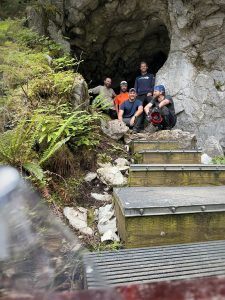
We met with Hannah and Ian at El Capitan. We unloaded equipment at the El Cap Interpretive Site, and parked our trucks on the road, before starting the hike to the entrance.
Orie:
After we arrived at El Cap, we met up with our two teammates, Ian and Hannah. Great fun people, with an immediately apparent drive and inspiration for caving. We secured the equipment we would need, and started to hike up to an elevation of 360 feet to the cave entrance—a distance of just under ¾ of a mile.
This took a number of trips, as the three divers alone had approximately four duffels of equipment each, weighing between 25-65 lbs. This included diving cylinders. It would have been a pleasant walk unencumbered, but with the equipment, it was a slog.
As we moved everything up to the face of the cave, and you could instantly feel the temperature change on approach. 65° F outside in the rainforest, with a pleasant pine smell, to a 42°-degree cave temp, with a familiar aroma of eternally damp rocks and quiet mud.
Originally, I was told that there would be six team members helping move bags. Little did I know that three of these haulers were us… “the cave divers”.
Ron:
To be entirely clear, I did tell Orie that he was going to be hauling gear. And I said there was going to be six team members. You can lead a horse to water, but you can’t make him cave dive in it…
Alex:
We moved all equipment to the entrance, then a second round of “fireman shuttling” the equipment behind the heavily-barred, locked gate that prevented entry from wandering locals or curious tourists.
We would get exceedingly proficient at the “fireman shuttle” as a team over the next week.
Ron:
We were getting chased by the rain during the entire time we spent in El Cap. We were getting constant concerned messages from the Forest Service checking on us, and while they seemed to be (rightfully) concerned with sumps in El Cap flooding, we never saw anything close to resembling a rise in water level, despite consistent rainfall during our time in the area.
It was this pressure, along with the enthusiasm and excitement generated by the energy of six-likeminded individuals setting out to discover something new at the end of a long road, which drove us forward that first day.
Frankly, it was almost as if we were compelled to do what we were doing. Not from a sense of brashness or lack of care; quite the opposite. This was something difficult, along an untrodden path, and we had to be careful, intentional, and diligent for every literal and metaphorical step along the way.
With that in mind, we started into El Cap with a shared focus to support ourselves and support the team.
At the time, however, I was much too excited to wax poetic.
 Part 3: Sumpin’ Special
Alex:
Initially, the passage was mostly mellow, boulder-y walking path. However, it soon became a long, downward crouch, low duck-unders, long muddy slides and scrambles, and trips up and down dripping outcroppings, all while shuttling the 700 lbs of equipment that we needed to safely conduct a cave exploration diving operation. We did this via fireman shuttles, handoffs, ropes, carrying, etc.
And finally, we hit the infamous Ball Bearing Passage.
Orie:
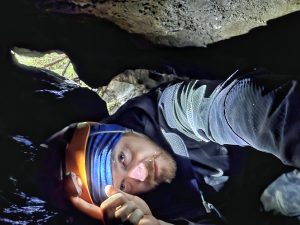
In this section of cave, your shoulders and chest are constantly touching the cave walls. You have to enter feet-first, you can’t see where you are going, and you have to hope that you just come out the other side. This passage is only about 25 feet long, but takes a considerable amount of time to wiggle through. In the narrowest parts, you can’t even draw a full breath. It’s tight.
If that wasn’t enough to make you say “never in a million years would I do that”, bear in mind: we had to pass every. single. bag. we. had. through this restriction. It is incredible to imagine the first person that looked at this and told themselves “I will see if I can make it through that.”
I am personally not a fan of these types of restriction, as it’s an easy thing to get wedged, stuck, and panic. And panic kills.
As for myself, I wasn’t concerned, but I wasn’t sure about other team members.
Ron:
Me. Orie is referring to me.
Despite having been a cave diver for many years, and having spent my whole life mountaineering and caving in one capacity or another, I’ve never been able to shake my air-induced claustrophobia.
Under the water? I’m 6’7”, 215 lbs, and could fit through the eye of a needle, better than any camel.
Above the water? I don’t even like narrow hallways or sleeping bags.
I think it has something to do with spending my entire life living on the coast of one massive ocean or another.
But, with the help (and gentle taunting) of the team, I sucked in my stomach and wiggled through, and started helping haul equipment up to the Cathedral Room, a tall room with a waterfall that had vaulted, continuing passage to our target: the sump at the far end of the Alaska Room.
Alex:
Just navigating Ball Bearing carefully and respectfully, and then getting the equipment up to the Cathedral Room, took us about 1.5 hours. For context, a capable caver can make the Alaska Room in under an hour, if moving relatively unencumbered.
Navigating this section of cave took us about as long as navigating the rest of it, combined.
Orie:
We rigged up and moved our team and equipment up and over the waterfall in the Cathedral Room, and we were greeted with our first sounds of success. A push of air through the cave, and the distant sound of tumbling water. The sound and breeze grew in strength, and at just over 3.5 hours from passing the gate to El Cap, we finally entered into the Alaska Room.
Ron:
The Alaska Room represents a lot of things to me. It’s why I moved to Alaska, its part of a region in my state I care deeply about, both ecologically, environmentally, and personally, and it’s likely the most impressive underground room I’ve ever been in (above the water).
But all I can remember from my first time taking it in was how staggeringly beautiful it was. I forgot I had a 70 lb frame pack on, standing there slack-jawed, until Kieran walked by me, caring an identical pack, and said “Chin up, big guy. We still have work to do.”
Orie:
The Alaska Room is the largest room in this cave system with a giant stream in the center of it, flowing over 400 feet of rock bed and boulders, and disappearing under a ledge into the Syphoning Great Beyond. The room stands roughly 500 feet tall, and about 1000 feet wide, wrapping around into a 90-degree bend. It is breathtaking, and beautiful, to see in-person.
As we stood taking in the beauty of this room, we remembered…
There are still a lot of bags to get.
Ron:
One my favorite moments during the whole project came when me and Kieran walked up to the Alaska Room Sump, and were standing looking at the springing water, pushing the river tumbling down the room behind us.
“You’re actually going to do it, man.” Kieran said, slapping me in the shoulder, “You’re going to keep pushing El Cap.”
“Absolutely not.” I told him, and threw an arm around his shoulder. “We’re doing this. I didn’t carry all those bags. I didn’t pick up our truck. I didn’t make it here. We made it here.”
And we both took in the moment, whooped and hollered like lunatics, before setting down the frame packs, and heading back to help the others.
 Part 4: Pull a Rabbit Out of His Cap
Alex:
Lots of cheers and high fives at the sump. I made some food for everyone, and team decided to dive that day.
I was tired from the haul, had topped one of my boots in the river of the Alaska Room (slipped on a rock), was starting to get cold, and was mindful of the endurance of the rest of group. That said, it was still early in the day, about 1:30 PM, so we reasoned we could go for a quick swim.
In retrospect, and when we return, diving days in El Cap will not involve that much physical exertion. We had traveled hard for 2.5 days, woken up at 5 AM, and hauled 700 lbs of gear a mile into the Earth. That isn’t taking anything away from the immense effort Ian, Hannah, and Kieran put in; we were all tired. The diving after that amount of work isn’t unsafe; however, it does tend to be much more abbreviated than it has to be.
But on this trip, we were all so excited, there was nothing we could do.
We had to dive.
Ron:
For all the excitement and build-up, once we started pulling drysuits on, rigging cylinders, and function-checking the equipment we would need to keep us alive (there’s a reason some people refer to this type of diving as “inner-space exploration”), we were all business.
No amount of dive training or classes can prepare cave divers for true exploration diving, and no amount of personal capacity amongst individual divers replaces the shared cohesion and efficiency that manifests amongst an experienced team.
While all accomplished in our own ways in diving, me, Alex, and Orie have worked together exploring caves underwater for years, both good dives and not-so-good dives, and we all trusted each other to be focused, honest, supportive, and safe.
As we geared up to enter the sump, the excitement faded away into the focus and clarity that always pervades these types of moments. Whoops and shouts were replaced with a quiet, soft dialogue, as Ian, Hannah, and Kieran moved through the team, helping stage equipment and hand gear into the pool.
It was time to go to work.
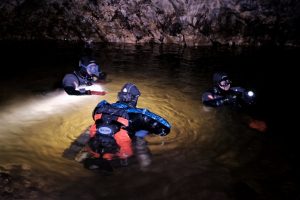
Orie:
After we did our pre-dive checked, briefed our teammates on how long to expect us to be gone, in case of an emergency (two hours), Ron started the dive, pushing our reel forward and laying line as he went.
The sump headed straight into a relatively large passage, with noticeable flow springing through the tunnel. Initially, there was a small restriction of rocks, but after that, we continued forward, laying line as we went. The main passage here was made up of medium-sized, smooth rocks, like a river bed. As we went, I noticed two leads, off to our left; one was much too small, but the other had some flow, and while very tight, could potentially offer more passage.
We continued through the main passage, and slowly began to ascend shallower, as we approached the next sump This room is called Diver’s Den, and was discovered by a group of true Alaskan, hardcore cavers, almost 30 years ago. Their purpose in exploration was to find more dry leads, and passage around the Alaska Room, whereas our purpose was more focused on the submerged portions of this section of cave.
Diver’s Den is about 75 feet high, and an equal distant wide, with a large breakdown pile running from right to left, as we observed it upon surfacing in the sump.
While the sump was not traversable in-water, we crawled out onto large rocks, similar to those in Ball Bearing, removed our fins, and walked across the rocks to the next sump, which was only barely large enough for all three of us to float, under a rock overhang.
Ron:
From all the research I did on El Cap, primarily consisting of old Alaska Caver publications and conversations with the cavers who wrote those articles, Diver’s Den looked almost familiar.
Almost.
This is a space that less than a dozen people (likely including living and dead) have ever laid eyes on, and it felt like I had been there, even though I had never seen much for photos, and only was working with a narrative account and a rough-sketch survey. It looked familiar, but something was off—like when something gets moved in your living room, but you haven’t figured out what it is.
Whereas Marcelle LaPierre had described a duck-under passage to his left, immediately upon surfacing in Diver’s Den, we saw only “ball bearings”. Whereas he had described the next sump (previously unexplored) as having a large entrance that continued to more passage, we found an impassable restriction blocked by even more ball bearings.
Clearly, in the 30 years since the original explorations, things had shifted. Whether that is by tectonic activity, gravity, or something else, is beyond my expertise.
Alex:
There was breakdown/rock fall mostly covering the bottom of the second sump, which was unexpected, but not unnerving. We took turns to go clear the rocks to have space to enter, being careful to avoid significant exertion that would lead to carbon dioxide buildup.
One of the last obstacles was a boulder, weighing about 50 lbs, wedged into the entrance of the continuing tunnel. I managed to get besides it, and lift it up and back, before pinning it beyond the restriction and to the side, where it couldn’t fall back towards the restriction, and couldn’t get knocked loose as we passed it.
At the bottom was our deepest point… at a staggering max depth of about 22 feet
But 2.2 feet, 22 feet, or 222 feet; we were now in virgin passage.
Orie:
Near the bottom of the sump was an ongoing passage, but it was blocked by small little rounds rocks and some of their much large siblings. Here, we took turns trying to clear the passage, in order to make it passable. After careful clearing and repositioning of breakdown, we were able to scrape through this tight, sidemount restriction, and continue on exploring the cave.
We explored another 300 feet before having to turn around. Max depth on this portion of cave was 17-23 feet with a 16 foot average, but the twists and turns the cave took we dramatic, with some sections of submerged cave less an a foot deep, before plunging back down 20 feet and continuing on.
Ron:
We named the restriction at the bottom of Diver’s Den continuing sump, “Marcel’s Looking Glass”, in honor of the man who had been the first person in the room (along with Craig Sempert), and had first documented this restriction.
While he had described a large opening six feet high, in the last 30 years, it had shrunk to something much tighter, and even in sidemount with very streamlined equipment, it was a wiggle and scrape to pass through. But it was underwater, and I barely noticed how tight it was, until I was exiting through it.
Looking through the restriction, with Diver’s Den at our back, the passage opened to a large, low tunnel, with it pinching down to the left, and the flow coming right-to-left. We went right. The tunnel behaved differently than most caves I have experience with. While some tunnel is cut by flowing water, and other tunnel is cut by time and the dripdripdrip of wind and erosion (referred to simply by cave divers as “dry” vs “wet” cave, in relation to how it is primarily formed), this was a combination of both, along with features I could only describe as “tectonic”.
The survey we did does not tell the whole picture. At one point, the tunnel seemed to terminate in an alley with no exit, and no source of water. After a minute of confusion, as I began to turn around, the tunnel seemed to tap me on the shoulder, and bring my attention straight up almost 20 feet. As I went up this chimney, I realized that there wasn’t a ceiling, but a massive piece of rock that was covering an insurgence of water. Sticking my fingers around the edges of the rock, I could see them refract in the air above the water, and feel water flowing against them. But there was no way to move this altar-sized stone.
As I began to turn around in the tight space (no easy task; like asking Santa Clause to spin around in a chimne), I saw that almost parallel to the chimney I had swam up, another chimney plunged down into more ongoing passage. With evident enthusiasm (I could tell I was a little excited, because behind me, Alex shot me a look that said “Yeah, yeah, yeah, calm down, Skippy.”), I plunged down that tunnel, head-down, laying line as I went, and trusting Alex to secure it behind me.
Everywhere was a lead, and every fin kick was a new space to explore and survey.
Alex:
Passage here was very tight. Where we lined-out, Ron attempted to navigate a restriction, thinking he could see air and ongoing tunnel, but in his efforts, destroyed the visibility. While this is expected during exploration, and nothing of concern to us, from my position, I did not think it was the best use of time, but I’ve been wrong before.
I waited behind him in no-visibility (imagine swimming in chocolate milk), with Orie’s hand on my calf; a signal that he was present behind me, as even our lights couldn’t penetrate the murk. Eventually, Ron overexerted himself, and either flustered or pissed, turned around and called the dive, tying off the line at the maximum point of penetration, and we began to exit carefully, validating our initial survey data that we collected on the way in.
Ron:
To Alex’s point, I was all three things; overworked and flustered, and then subsequently pissed at myself for letting the first two things happen. On the exit swim, I swore to myself I would be more conscientious of my teammates during the subsequent diving, starting from that moment.
Orie:
We were still within our 2-hour window when we turned, and slowly made our way back to Diver’s Den, tidying up survey notes along the way. The main passage stayed roughly 4-6 feet tall and wide. We had a few twists and turns that we stopped to explore along the way, including the lower, tighter portion of tunnel that we had observed upon first entering this section of cave.
Alex:
On the way back, I tied in a reel to examine the continuing passage that ran to the left of Marcel’s Looking Glass. This only went about 50 feet before it became too narrow to continue, due to rock fall that appeared to be a continuation of the same breakdown pile in Diver’s Den.
By this point, we were starting to bump against the time limit we had given the rest of the team back in the Alaska Room, so we started the return journey. I was also freezing cold, and we were all very, very tired, and still had to exit El Cap once we returned.
Orie:
When we resurfaced in the Alaska Room, Ian, Hannah, and Kieran were very excited to see us. We planned one more short dive to check the lead I had seen on our original dive to Diver’s Den, which Alex explored until it choked down, same as the other lead, and strongly suggested the main path of water cut around Diver’s Den. There is definitely more to explore.
Ron:
Marcel thought that Diver’s Den was an overflow of the main conduit of water cutting through the tunnel, and he was almost certainly correct. The two tunnels that cut around Diver’s Den seem to be the main path of the water, and due to the way things have settled in over the last 30 years, further exploration through these very tight restrictions could lead to some very promising exploration in the near future, albeit delicate and slow-going.
When we returned to the Alaska Room, we changed out of our dive gear, and started the trek out.
We each carried a bag, and our cylinders, which in retrospect, was a mistake.
At one point, I had to leave to beat a hasty exit for personal reasons tied to gastrointestinal distress.
I will let the reader guess to the outcome of this retreat, but I made it out of the cave.
Orie:
The amount of effort it took working equipment back up through Ball Bearing was a new level of taxing. Once through, we had the muddy slopes on the exit side to contend with. By the time we exited the cave that night, we were at a unique level of physical exhaustion, but the smell of the rainforest after over 12 hard hours underground was indescribable.
Alex:
We had entered El Cap just before 9:00 AM, and got back to our camp around 10:30 PM. Ron was too tired to eat, and most of us just laid out in various states of exhaustion.
Hard day. Good day.
While exiting, we had decided to pull our gear, and push other targets we had decided on during the planning phases. El Capitan was definitely the highest on our list, but given what we had seen diving, and the fact we were under pressure from supposed flooding, we were content with the work we had done, and had gathered enough data to support any future exploration.
But we still had 500 lbs of gear sitting in the Alaska Room we needed to get out, and with the rain drizzling constantly, that meant we had an early start.
Ron:
Not to exhaust the reader with personal details, but I had some serious family emergencies immediately prior to the trip, and by this point, I was emotionally and physically numb. Hannah let us know that the Forest Service was again concerned with the sump flooding, and implying heavily we needed to remove our equipment from El Cap as soon as we could, despite our permit being good for a week.
Orie, Alex, and Kieran were sleeping in a tent, Hannah and Ian were in their converted ambulance, and I was sleeping in the bed of Ian’s truck—partially to give the three in the tent more space, and partially because I’m accustomed to it.
It was midnight when we all finally turned in. I was dreading waking up at 6 AM to haul the majority of our gear out of the cave, but the fatigue stamped out my anxiety, and I was soon swallowed up by sleep.
 Part 5: Sometimes, You Just Say “Thank You”
Orie:
We started the morning with a good hardy breakfast at 6:00 AM. The rain had some concerned about one the passages getting flooded; if this happened, we would have to abandon the gear in the cave until the rain let up. By 7:00 AM, we were back at El Cap, and moving swiftly through the cave. Unencumbered with heavy kit, it took just 40 minutes to get to the sump and the rest of the gear we had staged in the Alaska Room the day before.
Alex:
There was a significant amount of rain forecasted during the week, and the passage below Ball Bearing has been known to sump, making it impassable. While we had been diving the day before, our surface support was checking this sump every 45 minutes, and while we were moving gear to that section of passage, we sent someone forward during that same interval, to ensure the water wasn’t rising.
Despite our precautions, it stayed bone-dry the whole time, which was a blessing, but at the time, we did not know this would be the case.
This shuttle run took us just over 2.5 hours, despite us being down a team member for the gear retrieval.
Ron:
I woke up with the feeling something was profoundly wrong. I should have been hurting from the work we had put in, and exhausted, and I was. But not enough.
As my eyes fluttered open, I could hear the rain, and see it running down the sides of the truck in the grey morning light.
“Waittasecond…” I thought to myself. “Why is it so bright, so early?”
I snapped upright and looked at my watch. 8:30 AM. Cursing, I crawled out of the bed of the truck, still wearing my clothes from the day before, and pulled my jacket on. Everyone was gone. I checked the tent and the ambulance, and jogged down the road to the El Cap parking lot.
They had let me sleep.
Feeling guilty and still reeling from waking up, I headed back to the camp, trying to collect my thoughts. I had no idea when they had left camp. I later found out Alex had gone person-to-person that morning, asking them not to talk loudly, as it would wake me up, and I wouldn’t be talked out of helping.
Feeling like a bum, I spent the next three hours doing what I could. I set up the generator that ran our fill station. I fixed gear. I filled cylinders. I cleaned the camp and prepped a lunch for their return. I fetched water from a nearby stream and refilled the portable water tanks we ran through filters. I did what I could, knowing damn well that the other five team members were working much harder than me.
Around 10:30 AM, I heard footsteps coming down the road. Kieran was the first, with a frame pack, and Ian was right behind him. I jogged down the road to thank them and offered to take their packs the rest of the way (a pitifully short distance, compared to how far they had come). They both declined, saying something to the effect of “You helped us get here; now it’s our turn to do some leg work.”
“Indescribable” is an overused term, but I don’t have the vocabulary to express the gratitude and humility I felt in that moment, and still feel to this day. Everybody collectively allowed me to rest (and I desperately needed it, although I would have never asked for it), and even went out of their way to ensure I did.
Alex:
When we got back to camp, we all snacked a bit, and I stole a few hours of sleep. It was raining hard and consistent at this point. At 2:00 PM, Ron and Ian called a meeting to strategize our next course of action. We decided to check a target that was very high on the list from early in the planning phases—Roaring Road.
Orie:
Due to the rising rain levels we agreed to go and look at a second dive site called Roaring Road. Less than a mile from the camp, we headed there sans dive gear, and to get a feel for the cave, before we committed to the process of moving dive equipment through it.
Ron:
The previous day’s enthusiasm had been replaced with a much more tempered approach. Hannah had suggested we walk Roaring Road without any gear, to get an idea of the approach, the system, and to scout what the water levels were doing. This turned out to be an exceptionally-sound plan, and afforded everyone some rest, after the previous 36 hours.
It also helped psychologically, as when we did move gear into the cave the next day, we could mentally brace for the amount of effort it would require, and ration our energy more efficiently.
Orie:
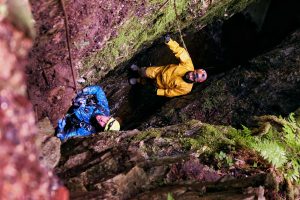
Roaring Road is a simple entry; about a 30-foot rappel into a slick canyon with a stream pounding the rocks as it cuts it’s path underground. Natural waterslides comes to mind. The cave is very uniquely cut marble and granite rock, as you wind and canyon through tall, narrow passage, step over and around deep, tannic pools of water, and scale small waterfalls as the roaring water slams directly into your chest.
All in all, nothing difficult compared to what we had done in El Cap, but entirely different than the previous two days.
Alex:
Once we were in Roaring Road, it only took 15 minutes to get back to the sump. Water levels were apparently high, which would be consistent with the constant rain. Despite our best efforts, everyone got a little went, and a few topped their boots in the river and pools. However, the sump looked amazing. We dropped a massive underwater video light down on a reel, and the visibility in the sump was about 30ft.
There is a very old cave diving line in the sump that is a monument to a story from an old caver, regarding a group of idiots from a film crew that tried to dive it 20 years ago, almost killed themselves, and said it was too dangerous, and then came out telling everyone that it was too dangerous to ever dive.
We disagreed.
And we were right.
Orie:
The story that was told to me was there was Australian team that dove here 20 years prior for a reality TV show. Soon after the dive, they told everyone that it was a massive mistake to dive it, and it was too dangerous to ever try again.
After we exited, our day ended non-eventfully back at camp, prepping gear and laying out a strategy for the next day. A quick dinner and off to bed after such a long two days of running in and out of Alaska room twice and then going into Roaring Road and back.
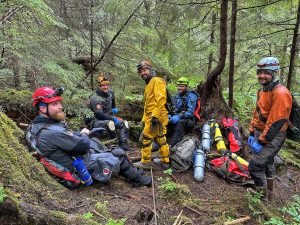 Part 6: Road Roar-ior
Alex:
We started later the next day, with breakfast at 8:00 AM, followed by loading equipment, and the divers changing into their drysuits. Roaring Road is much too wet to change clothes once you’re in the system, and given that we had some shelter from the rain at our camp, we opted to drive over wearing our gear.
The morning started with our truck brakes failing on a decent grade. One of the trucks we were borrowing takes some time to warm up, and given that Roaring Road was only a mile from the camp, the brakes never had a chance to come up to temperature.
This would not have been a huge problem, except the approach to Roaring Road starts on a fairly steep grade, on a one-way road, and we were pointed down it. Ron and Kieran were in the other truck, and they were driving up it.
Needless to say, this resulted in a measure of excitement.
Ron:
I was riding in the bed of Ian’s truck when we parked just short of the approach to Roaring Road. I crawled out, and saw Alex creeping downhill towards us, maybe 200 feet uphill. I started walking towards them to see where they plan to stop.
Through increasing emphatic shouting and arm gestures, I realized that they planned to stop at the bottom of the hill, and likely not before, unless acted upon by an outside force; the outside force most immediately present being our truck in the middle of the road.
The subsequent sprint back towards the truck and skillful maneuvering in reverse by Ian, and some heads-up driving by Alex, and everything was back on track.
Orie:
We arrived at the entrance to the cave and started to rope gear down. After the initial descent into the entrance, the cave pushes steadily back uphill, with the sump at the end providing a “headspring” that feeds the river cutting back through Roaring Road.
With all of the pools and waterfalls present in the system, walking in drysuits was actually quite pleasant. Only a handful of the waterfalls were taller than us, but there was almost no way to truly avoid them while hauling equipment. If we hadn’t been wearing drysuits, we would have been soaked to the bone as we carried the gear to the sump/spring.
Once we had moved cylinders and equipment in, we decided to rest in the 46 degree water, to cool off and slow our breathing and heartrate. Old reports from the site suggested a maximum depth of 73 feet, and our gas and dive was planned accordingly.
Narrative account ends here. There is more, but it has yet to be consolidated and edited. The original AKUEP team returned to Prince of Wales in 2025, and continued their exploration, and will continue to for years to come.
We aren’t in a hurry, because there is still much to be done.
Selah.
RLF